When literature intertwines with music, it creates a whole new world that can be a fertile ground in which both musicians and writers strive to experiment. As composers, we look for amazing and out-of-the-ordinary texts. Inspired by this, we can create or bring to life the world that the writer imagined. As choral conductors, we look for poems with outstanding word choice, energy, gaps, and leaps. These poems must evoke emotion(s) in the audience when they read them. After the composer adds music to this poem, and when a choir sings and the choir sings the poem –now song– it will transcend time and space, while reality shatters for a moment.
In this post we are going to see how Eric Whitacre (choral conductor, composer, and arranger) was inspired by Charles Anthony Silvestri’s poetry. This post will only expose the concept of what the philosophy of The Art of Musical Poetry is about. The pieces we are going to explore are: Sleep, Leonardo Dreams of his flying machine and Nox Aurumque.
Here’s an example of when Choral Conductor/Composer/Arranger Eric Whitacre (http://ericwhitacre.com/)makes a poems take flight (Charles Anthony Silvestri’s poetry) by adding music.
The first one we are going to examine is Sleep.
The evening hangs beneath the moon
A silver thread on darkened dune
With closing eyes and resting head
I know that sleep is coming soon
Upon my pillow, safe in bed,
A thousand pictures fill my head,
I cannot sleep, my minds aflight,
And yet my limbs seem made of lead
If there are noises in the night,
A frightening shadow, flickering light…
Then I surrender unto sleep,
Where clouds of dream give second sight.
What dreams may come, both dark and deep
Of flying wings and soaring leap
As I surrender unto sleep
As I surrender unto sleep.
Another one is Leonardo Dreams of his Flying Machine. This choral piece portrays a young Leonardo Da Vinci tormented by his visions of a flying man.
Leonardo Dreams of His Flying Machine
I.
Leonardo Dreams of his Flying Machine…
Tormented by visions of flight and falling,
More wondrous and terrible each than the last,
Master Leonardo imagines an engine
To carry a man up into the sun…
And as he’s dreaming the heavens call him,
softly whispering their siren-song:
“Leonardo. Leonardo, vieni á volare”. (“Leonardo. Leonardo, come fly”.)
L’uomo colle sua congiegniate e grandi ale,
facciendo forza contro alla resistente aria.
(A man with wings large enough and duly connected
might learn to overcome the resistance of the air.)
II.
Leonardo Dreams of his Flying Machine…
As the candles burn low he paces and writes,
Releasing purchased pigeons one by one
Into the golden Tuscan sunrise…
And as he dreams, again the calling,
The very air itself gives voice:
“Leonardo. Leonardo, vieni á volare”. (“Leonardo. Leonardo, come fly”.)
Vicina all’elemento del fuoco…
(Close to the sphere of elemental fire…)
Images of wing and frame and fabric fastened tightly.
…sulla suprema sottile aria.
(…in the highest and rarest atmosphere.)
III.
Master Leonardo Da Vinci Dreams of his Flying Machine…
As the midnight watchtower tolls,
Over rooftop, street and dome,
The triumph of a human being ascending
In the dreaming of a mortal man.
Leonardo steels himself,
takes one last breath,
and leaps…
“Leonardo, Vieni á Volare! Leonardo, Sognare!” (“Leonardo, come fly! Leonardo, Dream!”)
Charles Anthony Silvestri, 1965-present
And last but not least, Nox Aurumque.
This piece is the continuation of another piece titled Lux Aurumque. Whitacre wanted to create a second part to Lux aurumque and asked Silvertri to write something in Latin whose lyrics in Latin could be easily manipulated when sung. For all the background information, on how this piece came to be you can go to:http://ericwhitacre.com/music-catalog/satb-choral/nox-aurumque
Nox Aurumque
Gold,
Tarnished and dark,
Singing of night,
Singing of death,
Singing itself to sleep.
And an angel dreams of sunrise,
And war.
Tears of the ages.
O shield!
O gilded blade!
You are too heavy to carry,
Too heavy for flight.
Gold,
Tarnished and weary,
Awaken!
Melt from weapon to wing!
Let us soar again,
High above this wall;
Angels reborn and rejoicing with wings made
Of dawn,
Of gold,
Of dream.
Gold,
Singing of wings,
Singing of shadows.
Charles Anthony Silvestri, 1965-present
As you can see from these past examples, when Literature and Music intertwine, one can create worlds we can not imagine we could create, making the reader/audience forget about their reality and “abduct them” to the reality one creates when we are making music/reading/sharing a piece of literature. If only we took the chance to actually try and pursue this, just as our friend Eric and Charles, we can with “flying wings and soaring leap” create worlds that will forever stay… in our hearts… and minds.
Darkness…
Curtain call…
Hands on piano…
Baton at hand.
Darkness…
A Cm plays
Sound as water droplets fill the stage…
A progression of chords intertwine
An orchestra resurges like a phoenix from flames
A steady hand marks the tempo… as a conductor normally does…
“Molto legato e expresivo”
A life must be
“con passione e fortissimo”
One must live
Arpeggios and chords fill the space…
Filled with doubt and fear…
…of an uncertain future….
Memories remerge
As the orchestra quiets…
As a wave of emotions… in arpeggio form
The orchestra con forza reassures one destiny Why do I do this? Cause you live for it… I’m not sure… Yes you are.
Confusion dwells as the future emerges…
Plans come to shape and form
As one organize it
A clarinet… in the form of clarity reemerges
Arpeggios strike the heart… as a scale of hope.
Accents and dynamic a life is about
As the motif with variants fill up the sky…
Foreshadowing…
Flash backs…
A life yet to come…
A life which has passed…
Many live for this
So why can’t I?
Reassurance…. Apassionato e determinato
One must be… If not life becomes… an unlived dream.
Beautiful is life…
As one may not see
A future is certain
A past it will be.
The winds plays an expressive line
Chords accompany it … just as you accompany me…
Where there is darkness..
There is Light….
Where there is light
There is hope… Where there is hope… there is life… Thank you for breaking the darkness…
As the orchestra plays the final cadence…
The darkness is no more….
Molto legato e expresivo-> Very interlaced with expression. Con Passione e fortissimo-> With passion and loudly. Arpeggio-Notes of a chord played in succession, either ascending or descending. Con forza-> With force. Motif-> a distinctive feature or dominant idea in an artistic or literary composition. Appasionato e determinato -> Passionate and determined.
Life is music made tangible
Art is music for the eyes
Religion is music for the soul
God is the conductor if the galaxies
While humans are simply instruments
In his galaxy filled orchestra.
Sometimes we play sour notes
Sometimes we play beautiful phrases
Sometimes we play triplets
Sometimes in double time
Life is a andante molto legato e crescendo
while your love is presto con fuoco
if only you see me how I see you
in a caprichoso cantabile
in which the legato and stacatto meet
making the most beautiful counterpoint you’ll ever hear
That is my song for you
That is my life for the world
Compose your life as you would do a symphony
And it may be one of God most beautiful symphonies
he has and will orchestrate
you as its author and him as the conductor.
Life is like the most beautiful song in which you share your most inner feelings, state of mind. The song of you soul that you imprint on your loved ones and those lives united with your own can make the beautiful symphony that it is humankind” José A. Clavell
Sorry I haven’t blogged for a while but this semester has been crucial, stressful, with new challenges and with life changing oportunities. I will briefly talk about my choral conducting course and experiences I’ve had this semester.
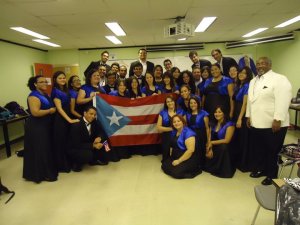
As a parenthesis before I started this Fall semester, I went to Vermont/Canada with the PUCPR Concert Choir and we participated in a 3 day tour in Vermont and 4 days in the Loto-Quebec International World Choral Festival in as the name states in Quebec, Canada. Even though it was only one week I had the chance visit and get out of this Island (which was a first) and experience and ultimately share with the rest of the world Puertorrican Music with my friends and with my mentor/director Prof. Ruben Colon Tarrats. This was a wonderful experiments for me specially since this semester was my Choral Conducting course, and in July I was part of a 5 week workshop of Renaissance Music with other 11 companions with my professor Mons. Abel Di Marco where we learned on how to sing this particular type of music. Another experience if we flash forward to mid november with this group “ArsAntiqua” which we specialize in Renaissance Choral music we had our first public performance, which was part of the Opening activities of the Re inauguration of the Ponce Art Museum. After all this Summer was a very productive one since I had the chance to experiment with different choristers, and specially different genres of the choral repertoire.
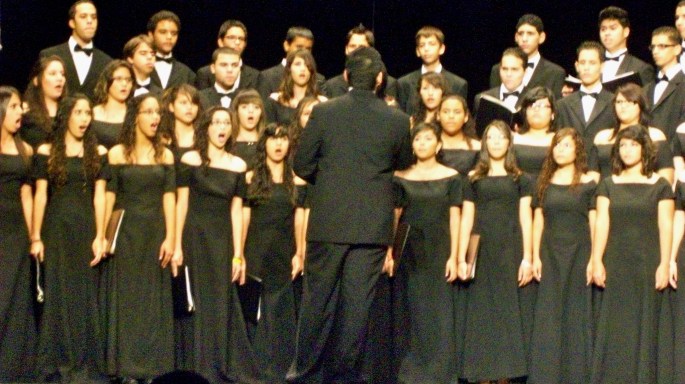
This Fall semester I had the chance take/be a part of, like 6 other fellow musicians, the Choral Conducting I course, which is the last music course that offers the PUCPR for the Music Department. If I had to describe the course is… pretty hard… the only words that can I fathom are.. stressful, challenging, rewarding, awesome, etc. This is an amazingly challenging course because, first of all the choir is used for only ONE conductor aka: Ruben who has been the conductor for almost 18 years, also you are a rookie (even though if have been dreaming of conducting a choir since you’ve graduated since high school like me) and this is one of the many challenges you encounter. This course is an eye opener because… for the first time you know and feel what your teacher feels like, like for example when you get frustrated because the music is behind, etc. It is also an experience *even if you don’t or don’t peruse choral conducting as a career** (because the true of the matter is that if you are an Education Major and if you go to a public or private school you have to conduct the choir…) But as part of being a conductor (and as a musician) is to.. PERFORM, which happened last Sunday December 5th, 2010, in which is the traditional debut of the student conductors in which I conducted a Venezuela Traditional Christmas Song called “El Niño Criollo” a Choral Arrangement by Caron Montaguatelli, where it describes Jesus Christ as a Venezuelan Child dressed in traditional clothes..
A fun fact was that through the semester one of my first music teacher who we call out of love Fombe, called me and she basically gave me a song to conduct at the prestigious La Perla Theater in their annual Christmas Concert, this was an absolute shocker!!!!! ME, conduct where!? jajajaja I still can’t believe that actually happened because there was still students who I know since I was a student there, from when I started music long ago in 2002. To be frank it was another amazing experience and they want for me to be a guest conductor for their Spring Concert in May, which is mind boggling!!! In that
Concert I conducted a christmas song called “Llevame a ver a Jesus” a SATB arrangement by Noel Estrada. I wish that this continues… whether it be conducting the IMJMC Concert Choir, sing with ArsAntiqua and along the Choral Municipal Choir (which I am a part of since this semester, this is the only municipal group in Puerto Rico, and it sings beside the Ponce Municipal Band, both are conducted by Ruben Colon Tarrats)
I’m sure that a lot of great things will happen this new semester and year!
This is another essay I have to write for my English Course hope you like it. As usual feedback is appreciated
After many years of research, psychologist Dr. Rausher and neurologist Dr. Shaw revealed to the unsuspecting world that Mozart’s music had positive effects on children, teenagers, and adults. Mozart’s Music is perfect for its phrases, periods, and movements result in balanced, nimble, and crystal-clear pieces which are recognized throughout the world; for instance, his Sonata for piano #24 and his Lacrimosa in his unfinished Requiem. These pieces, with their melodies, harmonies and counterpoints, significantly improve children’s motor skills and help them focus on their studies for a short period of time. Mozart left us with a beautiful legacy from which the human mind can benefit thanks to its perfect harmonies, logic, and genius.
“The Magic Flute,” “Don Giovanni,” “Cosí fan tutte” and “Eine kleine Nachtmusik” are examples of the prodigy that was Wolfgang Amadeus Mozart. Whether improvising on the harpsichord or on the violin at the tender age of eight, Mozart wrote his first work of art- a symphony; when his father saw this, he dedicated his life to teaching his son music. Mozart played concerts through London and Europe when he was fifteen years old; powerful, humble, mesmerizing, and beautiful were his melodies that the great composers and musicians of the era called him a prodigy. Consequently, the critics craved for more and even though Mozart’s genius gave us pieces such as “Ave Verum Corpus,” one of his most recognized choral pieces; unfortunately, he died at age thirty-five when he was just finishing his Requiem, the Mass for the Dead. But what is this Mozart Effect people are talking about?
In 1993 in the University of California some human test subjects, 36 high school students, became part of the Mozart Effect experiment, in which after the heard Mozart’s Sonatas these students were given a standardized test. The result of this test showed an increase in the temporal spatial levels among other results. Dr. Tomatis, in 1997, wrote that whether or not his patients liked Mozart’s music, they were more relaxed and made them express themselves more easily and openly to him; thus his conclusion was that Mozart’s music has the ability to heal the patient’s heart and clear their brain. As a result of both Shaw’s and Tomatis publication, The Mozart Effect gained worldwide attention in a matter of minutes, for many teachers, professors, and parents adapted said effect onto their students and children respectively. This effect is lasts in periods of five to ten minutes.
The Mozart Effect on children is highly effective, especially with those students from kindergarten to third grade. My sister, a Second grade teacher, did a little experiment where she gave the first test of the semester with a “normal” ambiance (without music) and her students received average grades; however, on the second test she administrated a math test where the students heard Mozart’s Piano Sonata #21, the students who got a C or C+ on their first test received a B, B+, or A on their second test. From that day on my sister, Mrs. Clavell, administers all of her tests with classical music. Parents and teachers alike misunderstand the concept of the Mozart Effect, for they believe that if they don’t have Mozart’s music, the effect won’t work and they are sadly mistaken; for example, you can use Beethoven, Vivaldi, or Pachelbel’s Canon and still observe the same results. Children, who are exposed to this kind of music, as commented before, improve their IQ, focus, and motor skills.
The Mozart Effect is an area that unites pedagogy, parenting, music, and psychology. Mozart is one of the greatest composers of our time, for his nimble, humble, and mesmerizing melodies that captivate our hearts and clearly our brains. Mozart and his effect clearly has had a positive impact on us; hence the studies continue to grow and the testimonials of parents and teachers alike of how this effect works. So greatly is the impact of this effect that Disney has used this effect in marketing, with its most popular infant and toddler merchandise called “Baby Einstein.” These DVDs and CDs use classical music with colorful stories and toys to capture toddlers’ attention and with games they start to recognize musical patterns, rhythms, vowels, and words. Mozart shall live on in our lives and in many years to come, new scientists and musicologists will still try to unlock the mystery behind Mozart’s music.
This is one of the many assignments I have done this semester in my English 224: Grammar and English Writing with our Professor Dr. Ana Montero. She is wicked awesome and truly knows her grammar and English history. What can I say… she has a PhD in LINGUISTICS. I hope you like it. Its supposed to be an Classification Essay and I wrote about people memories and places I have been at. Feedback is wonderful as usual.
How can a song from a certain decade make you remember an experience or feeling from your past? Why do these songs, through their lyrics or harmonies, stay on society’s mind and are guarded with such care? Maybe it’s because they have influenced your decision-making or train of thought on a particular subject. The songs we listened in class made me reflect on places I have visited, the people I have met, and some of the best memories of my life.
When I heard “Let’s twist again” by Checker it reminded me of “Surfing USA” by the Beach boys, and for a moment, I re-lived the vacation I had with my family in Culebra, and all the music I heard on the beach. When we went to Flamenco beach, one of the songs we heard was “It’s my party” by L. Gore which everybody was chatting about the “good old days” and how the world’s situation was at that time. Looking back on this vacation, I remember the peace, tranquility, and fondness I had at night which reminds me of “Can’t take my eyes of you” by F. Valli & 4 Seasons which makes me want to go Culebra again.
After the audio excerpts, I automatically thought of three people in my life who are part of the university choir: Sheila Cruz, Aledra Rodriguez, and Yaletza Peralta. You may ask yourself “why”? The answer is because they are fans of the following songs “Bad Girls” by D. Summer, “Mama Mia” by ABBA, and “The way you look tonight” by T. Bennet. Since they know these lyrics by heart at any given moment on any given day, they will (by a force of unknown magic) harmonize these songs in such a creative way that after five minutes you’ve experienced these songs with a whole new arrangement.
“Killing me softly” completely re-awoke some of the best memories in my life. When I started to study music seven years ago; in my first semester my choir teacher gave me a solo, and I felt just like R. Flack.On the day I had to sing, I thought it was going to be awful, but it went surprisingly went very well. All of those feelings of wanting to die with what felt like a lead ball in my stomach paid off because the song sounded well, and everybody liked it. Also “Un-break my heart” reminded me of the time in my senior year when I had to choose between singing and playing in my last concert in the Institute or going to my high school graduation; this was the hardest decision I had to make in my 20 years on this Earth. After careful consideration, I chose to go to my high school graduation because my Alma Mater is very important for me, for it is where I have spent 14 or more years. And I knew it would not be the last concert I would participate in my life. Furthermore, I won’t forget during that senior year when I directed the String Ensemble on the last activity of the semester. That experience made me realize what I wanted to do with my life: to conduct, direct and compose for Ensembles and choirs.
Places, people, and memories are some of the things you will carry in your life forever. Based on that premise is what an individual must have in mind every day. All of the experiences we will have in your life, for better or worse, will teach you a lesson in which you must try to practice each day. Whether it’s classical or popular music, music will consequently make you remember your past experiences and thus make you reflect in life itself.

 The art of musical poetry